Brass Edges and Crimson Turns: How to Read a West End Auditorium Floor
Photo: Shazz , CC BY-SA 2.0, via Wikimedia Commons
You've found your seat, shuffled past the knees, wedged the coat under the chair and done the silent phone check. Lovely. Now look down. The floor of a West End auditorium is the most-trodden archive in the building, and it is absolutely worth a minute of your attention before the curtain goes up.
Carpet in a theatre is never just carpet. It is wayfinding, sound-swallowing, spill-hiding, complexion-flattering house dressing. It is also a maintenance decision made by someone who knew that 1,200 people would walk over it six times a week. Read it properly and you can date a refurbishment, spot a listed interior and work out where the ushers actually stand during the interval.
The Red Isn't Just Red
There's a reason so many houses settle on a deep, warm red — sometimes a lacquer crimson, sometimes a softer claret, occasionally something closer to oxblood. Under warm auditorium lighting, red reads as glamour, it hides a multitude of sins, and it makes most skin tones look better than a chilly grey ever will. It is the theatrical equivalent of a flattering wall colour.
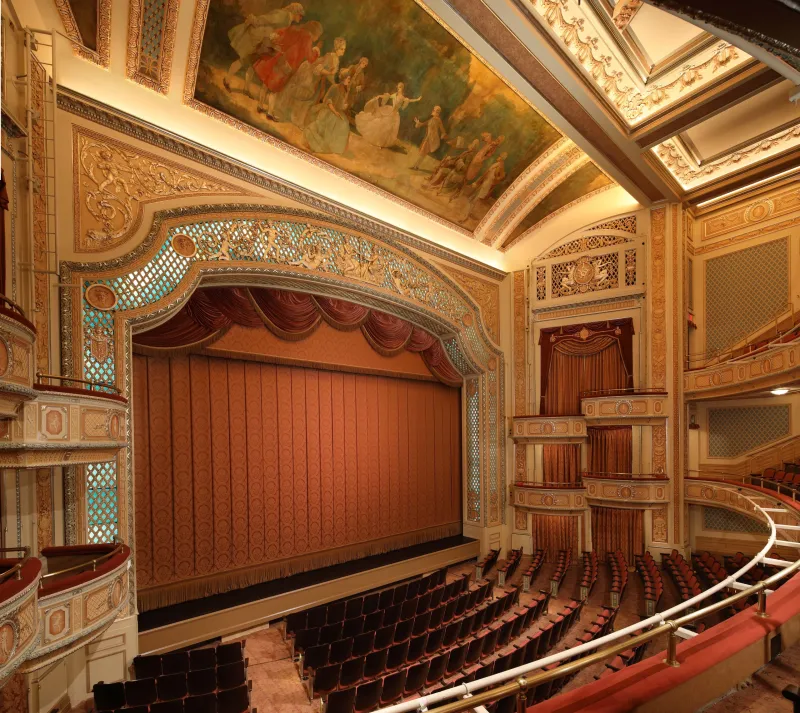
But the shade is a clue. A bright, saturated red with a fresh sheen usually points to a relatively recent scheme, where the carpet was specified alongside new upholstery and paint. A deeper, slightly muted red, less even underfoot, tends to belong to an older house where the carpet has been replaced in sympathy with a historic interior rather than in pursuit of a trend. Theatre Royal Drury Lane's post-refurbishment scheme leans into that richer, heritage red with gold detailing, which is exactly what you'd expect from a building that has been reintroducing its historic bones. The Savoy, meanwhile, has Art Deco in its DNA, and its floors tend to favour stepped, geometric motifs over florid scrollwork. You can usually feel the difference before you consciously see it.
Patterns Are a Maintenance Strategy
A busy little pattern is not a design coward's choice. It's a very practical way of hiding lint, scuffs, dropped sweets and the faint grey bloom that appears wherever a thousand shoes have paused. Small repeats and speckled grounds forgive wear. Big, open motifs do not — they show every mark, which is why you often find them in foyers and bars rather than in the auditorium itself.
Borders are the other giveaway. A strong border running along the aisle and around the doorways is a visual instruction: this is the walking route, this is where you queue, this is where you don't cut across. In older houses, the border may be a separate carpet entirely, stitched or fixed with a brass edge. In newer schemes, it's often woven in. If the border lines up neatly with the doorway and then stops dead at a service door, you're looking at a refurbishment that had to make a decision about where the public realm ends.
Brass, Rubber and the Biography of a Stair Edge
Stair nosings are the unglamorous heroes of this whole story. That's the strip along the edge of each step — the bit your toe finds in the dark. Brass is the classic West End choice, and a polished brass nosing will develop a soft, bright curve where generations of feet have hit the same spot. If you want to know where people actually walk, ignore the centre of the stairs and look at the shine.
Aluminium or silver-coloured nosings often suggest a later refurbishment, or a pragmatic repair where the original brass was too worn to save. A painted yellow stripe is the honest, municipal solution — less romantic, extremely effective. And then there are the aisle runners, often held down with brass rods. Listen for the tiny clack when someone catches one at speed; it's one of the most recognisable sounds in a British theatre, up there with the ice-cream tub lid and the whispered "sorry" of a latecomer.
Three Floors, Three Personalities
At Drury Lane, the floor is part of the grandeur: rich red, gold-adjacent detailing, a sense of a scheme that was designed to be photographed as much as walked on. At the Savoy, the geometry does the talking — smaller motifs, cleaner lines, a touch of Deco precision that suits the building's 1920s rebuild. At a smaller, older house such as the Lyceum or the Gielgud, you may find a more domesticated scale: narrower aisles, tighter turns, a carpet that has been asked to do a lot with very little.
None of this is accidental. A large house with a deep stage and a wide stalls rake can carry a bigger pattern. A tight, tall auditorium needs a carpet that doesn't shout over the plasterwork. The floor is always in conversation with the ceiling, even if nobody in Row H is listening.
What to Notice From Your Seat
You don't need a torch or a backstage pass. Just a few small observations:
- The nosing shine. Look along the aisle step nearest you. Where is the brass brightest? That's the line people take in the dark.
- The seam. Find where two widths of carpet meet. A neat, tight seam suggests a careful fit; a visible ridge suggests a budget or a quick turnaround. Both are honest.
- The crush under your seat. The pile beneath the seats is usually flatter than the aisle, pressed into a soft U-shape by years of heels and handbags. It's the only part of the auditorium that gets sat on in the dark.
- The doorway border. Does the pattern stop cleanly at the door, or run under it? That tells you whether the scheme was designed for the room or laid down around it.
- The ghost patch. Look near radiators, bar hatches and fire exits for a slightly newer square of carpet. Every theatre has one. It's usually the most recent repair and the least glamorous thing in the building.
The Interval Test
Come back to the same spot in the interval and watch the floor do its other job. The ushers will walk the same line they always walk, the audience will drift towards the bar in a predictable tide, and the carpet will take it all without complaint. If you're very lucky, you'll catch the faint smell of warm dust and carpet shampoo that means the house has been properly looked after.
A West End floor is not the star of the show. It is the thing that has been there for every first night, every final performance and every frantic get-in in between. Look down before the lights dim. It's the most honest review in the building.