Below the Stalls: Rosin Dust, Red Velvet and the Secret Style of the West End Pit
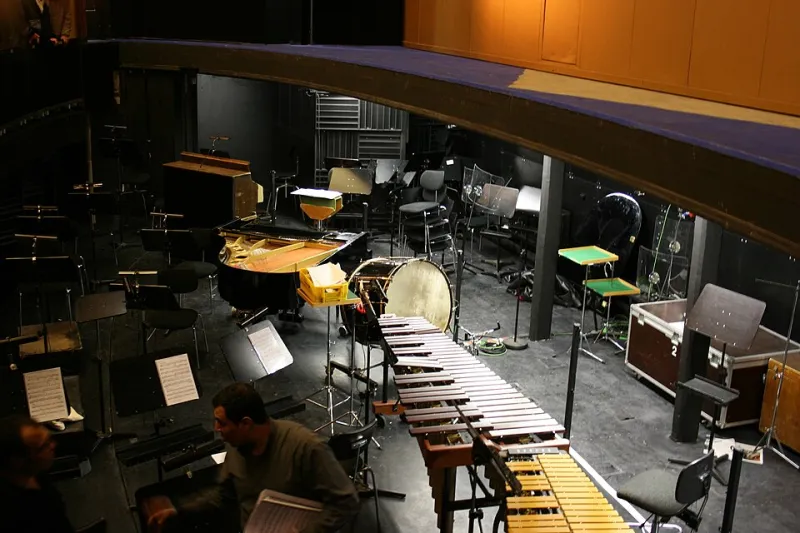
Photo: Frank Vincentz, CC BY-SA 3.0, via Wikimedia Commons
From the front row, the orchestra pit looks like a rumour. A pale glow of music stands, the occasional top of a head, a violin bow rising like an antenna. Then the house lights dip and the pit becomes the engine room of the entire evening — hidden, hot, and far more stylish than anyone in Row A is ever likely to notice.
Up in the auditorium, all the glamour is accounted for: the red velvet, the gilt, the ushers with their torches. Down below, the glamour is quieter. It smells of rosin and coffee. It sounds like a pencil sharpener and a whispered joke. And in 2026, as West End schedules get tighter and pits juggle more doubles than ever, that hidden world has developed its own codes, rituals and wardrobe rules.
The blackout uniform that isn’t quite uniform
Pit dress is usually black, but do not mistake that for bland. The orchestra is a workplace in shadow, and black is practical: it disappears under the lip of the stage, it hides a coffee stain, it keeps the eye on the conductor rather than the cufflinks. But within that black there is room for personality. A velvet jacket with the sheen of a good curtain. A silk scarf in deep burgundy. A pair of perfectly polished loafers that will never be seen by anyone except the second clarinet and possibly the deputy stage manager.
The style rule is not “look glamorous”. It is “do not distract”. No flashing trainers, no jangling bracelets, no shirt so crisp it squeaks when you lift a bow. A musician friend once described pit dressing as “funeral formal with better posture”. You are dressed for a serious occasion, but you are also dressed to sit very still in the dark for two and a half hours without rustling.
And yes, there is a certain glamour in that. The pit may not get a curtain call, but it gets the red velvet above its head and the knowledge that the whole room is breathing in time with it.
Peppermints, pencils and the pre-show kit
Every pit has its rituals, and most of them fit into a small bag. Peppermints are close to universal — the strong ones, usually, kept in a tin that is opened before the half and then shut with tremendous care. There are pencils, erasers, glasses cloths, a spare pair of black socks for the musician who has cycled through a November drizzle, and the inevitable emergency snack that is eaten in the interval with the guilty speed of someone who has eleven minutes and a tuning check.
Rosin dust is the other great pit accessory. It settles on black trousers like a faint constellation. String players brush it away with the side of a hand; everyone else learns to ignore it. The pit floor after a long week can look as if someone has been lightly dusting a bakery. It is not glamorous in the magazine sense, but it is specific and intimate, and it tells you that the music is being made by bodies, not by a speaker system.
Reading the eyebrow
Pit musicians do not need a loud voice. They need a good conductor and a better pair of eyes. A raised eyebrow can mean “slower”. A tiny flick of the baton can mean “watch the brass”. A look held for half a beat too long can mean “we are not together, and we both know it”.
From above, the conductor is a silhouette. From below, they are a face and a pair of hands and a shoulder that either relaxes or does not. The orchestra reads all of it. They also read each other: the principal’s bow arm, the drummer’s nod, the way the keyboard player turns a page. In a good pit, the communication is almost entirely non-verbal. In a great pit, it feels like a conversation held at a very low volume in a very small room.
Quick changes without a costume rail
Pit quick changes are not the same as backstage quick changes. No one is being sewn into a ballgown behind a flat. But woodwind players double instruments, percussionists swap mallets, and string players retune in the gaps. There are flurries of movement that look, from the outside, like nothing at all: a flute put down, an oboe picked up, a page turned, a mute fitted, a bow re-rosined in the dark.
That is the pit’s version of a quick change — silent, precise, and entirely invisible to the audience. The wardrobe equivalent is the quiet adjustment: a jacket off, a sleeve pushed up, a scarf retied during the interval. It is all done with the same economy. Nothing flashy. Nothing that would pull focus from the stage.
Why the least visible people set the tone
Here is the thing about the pit: it sets the temperature of the whole building. If the orchestra is sharp and alert, the show feels sharp and alert. If the pit is sluggish, the audience may not know why the evening feels slightly flat, but they will feel it. The musicians are the first people in and the last people out, and they carry the show’s pulse in a way that never gets a review.
They also carry its manners. The pit is one of the last places in the West End where quiet is genuinely enforced — not by a sign, but by collective agreement. You do not talk through the overture. You do not rustle your sweets. You do not check your phone, because the glow would travel. It is a small, strict, deeply civilised world, and it makes the auditorium above feel grander by proxy.
So next time you settle into the red velvet with a programme on your knee, spare a thought for the black-clad people below. They are not the support act. They are the floor the whole night stands on. And they look rather good in the dark.