Brass, Black and a Perfectly Pressed Collar: How a West End Foyer Introduces Itself
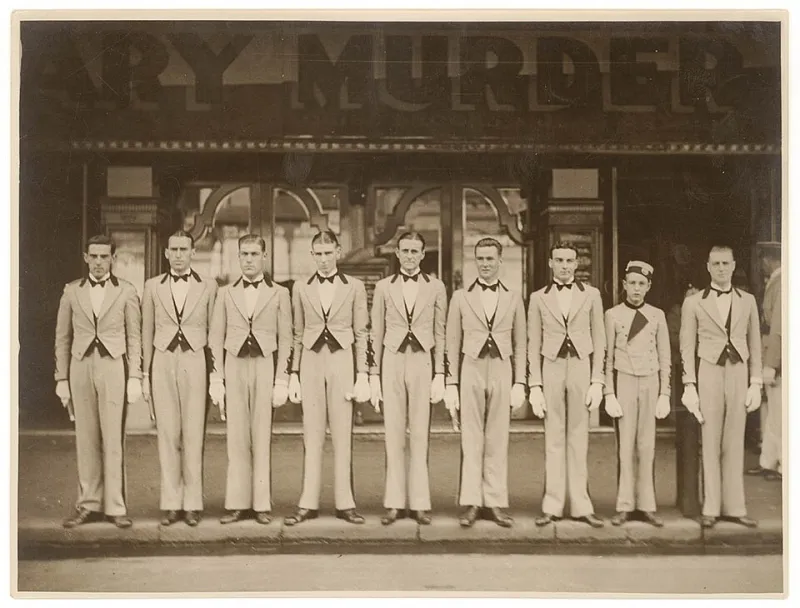
Photo: Sam Hood, Public domain, via Wikimedia Commons
You can learn a surprising amount in the eight seconds it takes to hand over a ticket. Not from the ticket. From the sleeve that takes it.
West End front-of-house uniforms are the most-read, least-discussed costume design in London. They are chosen months before opening, budgeted like a lighting rig, fitted like a show, and then worn by people who have to sprint up three flights of stairs in them while carrying a bucket of ice cream. Nobody writes about them. Everybody reads them.
So let's read them properly.
The Waistcoat Is a Mission Statement
Walk into one of the big musical houses off Shaftesbury Avenue and the first thing you notice is the shine. Brass buttons. A brocade or jacquard waistcoat that catches the chandelier. A collar that has been pressed by somebody who cares, possibly somebody who is paid to care.
That waistcoat is not nostalgia — it's a promise. It says: we have a merchandise queue that stretches past the bar, we have a ten-minute changeover, and we would like you to feel like the evening started the moment you crossed the threshold rather than the moment the curtain went up. Big musicals sell glamour as a product, and the foyer is the shop window. A front-of-house team in costume-adjacent tailoring is the soft launch.
It also does a practical job. Those waistcoats are almost always a heavier wool blend with a bit of give, because the people wearing them are lifting booster cushions and crouching to check seat numbers in the dark. Look closely at a well-made one and you'll spot reinforced stitching at the armhole. Glamour with a load-bearing capacity.
Black on Black, and the Quiet Houses
Then there's the other end of the scale — the small houses, the studio spaces, the producing theatres that have been on the same street since before anyone thought to call it a cultural quarter. Black shirt. Black trousers. No waistcoat, no brass, no fuss. Often no name badge at all beyond a discreet embroidered line on the chest.
A front-of-house supervisor I chatted to at one of the smaller central London venues put it neatly: "The black is a courtesy. It means we disappear when the lights dim, and it means nobody has to think about us."
That's not a lack of care. It's a different kind of confidence. A venue that dresses its staff down is usually telling you the work on stage is the only ornament in the building — and that you're welcome to be comfortable in your own coat rather than impressed by theirs. If the usher's uniform is barely there, expect a programme with an essay in it and a bar that takes cash.
Rank, Fabric and the Hierarchy You Can See
Here's the thing nobody mentions: uniforms are an org chart you can read from the stalls.
At most West End houses, the front-of-house manager wears the sharpest version of the house look — a full jacket, sometimes a different button, occasionally a pocket square that nobody has authorised but everybody tolerates. Supervisors tend to get a lapel detail: a pin, a different badge, a slightly better fabric. The casual staff, often on shift-by-shift contracts, get the off-the-peg version and a lanyard.
Lanyards are the great giveaway. A house with no lanyards is a house that has spent money on tailoring. A house where everyone is wearing a lanyard has spent money on radios instead — which tells you the venue prioritises crowd movement over aesthetics, and honestly, at 2,000 seats, fair enough.
And look at the lapel itself. A radio earpiece means a house that takes security seriously and has likely had a difficult conversation about it in the last few years. A first-aider pin means a building with an ageing audience and a sensible plan. A charity pin or a rainbow badge means management has stopped policing self-expression, which is usually a sign of a happier rota.
What the Sleeve Says About You
We talk endlessly about what to wear to the theatre — the faux fur, the velvet blazer, the good shoe that can survive a spiral staircase. Less often do we admit that the uniform sets the sartorial temperature we're all responding to.
Stand in a foyer full of brass and brocade and your jeans start to feel like an apology. Stand in a foyer full of plain black and suddenly a nice knit is plenty. The house dresses itself; you dress to the house. That's the unspoken dress code, and it's written in fabric.
There's a practical read here too. If the ushers are in soft, dark, silent fabrics, the building expects a dimly lit auditorium where people move during the show. If they're in a stiff waistcoat and a hard-heeled shoe, you're in for a house with formal sightlines and a firm line on latecomers. Neither is better. Both are information.
A Foyer Reading, in Five Glances
If you want to play the game properly on your next night out, here's the shorthand:
- The fabric sheen. High sheen and structured shoulders: a house selling an event. Matte and soft: a house selling a play.
- The badge. Embroidered: money has been spent and staff are probably kept. Sticky label: opening week, or a staff shortage, or both.
- The shoe. Properly polished: a house with a dress code for its own people, and probably a firm view on yours.
- The lanyard. Present: a practical building. Absent: a self-conscious one.
- The stance. Ushers who stand at the door and greet versus ushers who stand behind a lectern and scan — that's not laziness, it's a decision made in an office in March, and you can feel it all night.
The Verdict
None of this is about judging the person in the waistcoat; the person in the waistcoat has been on their feet since 5.30pm and is doing you a kindness. It's about noticing that in a city where a West End ticket can cost more than a weekend's food shop, the theatre has still bothered to make a decision about what the first human being you meet should look like.
That decision is a mood, a budget, a hierarchy and a brand, all pressed into one collar. Read it on the way in, then forget it, buy a programme, and enjoy the show.
The best-dressed foyers, in my experience, are the ones where nobody's uniform is doing all the talking. But a good brass button never hurt anyone.