Dark Monday, Bright Mop: Inside the West End Theatre That Never Really Closes
Photo: Warren LeMay from Cincinnati, OH, United States, CC0, via Wikimedia Commons
On a dark Monday, the pavement outside a West End theatre looks like a lie. The doors are shut. The posters are still there, but nobody is queuing under them. No programme sellers, no warm-up playlist, no last-minute lipstick check in the reflection of a phone screen. It reads as a day off. Inside, it is anything but.
The dark day — usually Monday, sometimes Sunday, depending on the theatre and the show — is the one day when the building can be taken apart and put back together without an audience in the way. It is not a rest. It is a reset.
The 8am walk-round
The first person through the stage door is rarely an actor. It is more likely a duty manager, a building supervisor or a production manager with a clipboard and a torch. The walk-round starts at the front of house and ends somewhere near the back of the stalls, and it is less glamorous than it sounds. A handrail is loose. A toilet door bounces. One of the aisle lights flickered on Saturday night and nobody had time to look at it. The weekend has left a list.
On a show day, that list waits. On a dark day, it gets attacked.
Rigging, ropes and the quiet ballet above your head
Above the auditorium, the fly floor is having its own Monday. Bars are checked, ropes are inspected, counterweights are counted. The grid is a workplace, not a backdrop, and the people up there are not thinking about the view. They are thinking about load, wear and the fact that a piece of scenery will be flying in and out eight times a week until further notice.
It is one of the least visible parts of theatre and one of the least forgiving. A wobbly flat on stage is a problem. A tired rope on the fly floor is a different category of problem. The checks are methodical, repetitive and mostly silent. The only soundtrack is the clank of metal and the occasional instruction across the void.
The carpet question
Then there is the carpet. Everyone notices the auditorium carpet when it is new. Nobody notices it when it is clean. They notice it when a Coke has gone over in Row K, or when a winter of wet coats has left a dark tide mark along the aisle.
A dark day is often carpet day. Shampoo, extract, dry, repeat. Upholstery gets the same treatment. Stair nosings are checked. Gum is scraped. The front of house team works through the foyer and the bars, and the whole place starts to smell faintly of clean water and effort.
You cannot do this at 7pm. You can do it on a Monday, with the doors shut and the heating on, and hope it dries before Tuesday's half-hour call.
Dressing rooms, drains and the ghost of Saturday
Backstage, the dressing rooms have their own Monday ritual. Bins are emptied. Surfaces are wiped. Laundry goes out and comes back. The wig room has its own list, because wigs do not care about your day off. Sinks are descaled. Showers are checked. Somewhere, a drain is always being unblocked.
The dressing room bin is a surprisingly honest document. Coffee cups, make-up wipes, a torn call sheet, a note that says 'buy throat sweets'. It is the residue of a company that has been performing at full tilt and is now briefly allowed to be ordinary.
The silence that is not silence
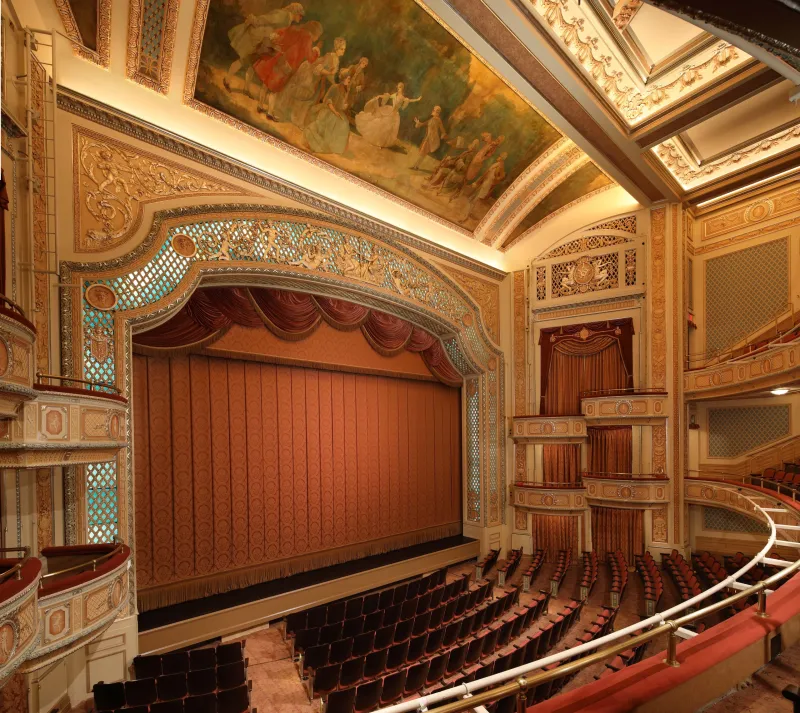
The strangest part of a dark day is the auditorium. Without an audience, it is a different room. You can hear the building. Pipes tick. Seats creak when nobody is in them. A radio plays somewhere near the bar. A vacuum starts and stops. The ghost light is on, as it should be, and the stage looks bigger and more naked than it ever does at 7.30pm.
It is not eerie, exactly. It is honest. The theatre is a machine for holding attention, and on a dark day the attention is turned off. What is left is the structure: the ropes, the bricks, the carpet, the drains, the people who know which door sticks.
Before the next audience
By late afternoon, the building starts to change gear. A rehearsal might come in — understudies, covers, a tech tweak before the next performance. A lighting desk gets a note. A quick repair is signed off. Someone walks the front of house with a bin bag and a roll of tape.
The dark day does not end with a curtain call. It ends with a building that is ready to pretend it was never touched. The doors will open, the playlist will start, the programmes will be stacked, and the audience will walk into a room that smells faintly of clean carpet and looks exactly as it should.
That is the trick of the West End's day off. It is not a day off at all. It is the quiet shift that makes the loud ones possible.