The Warm-Up Nobody Claps: Inside the West End's Pre-Show Playlist
Photo: Jenny Wren 64, CC BY-SA 4.0, via Wikimedia Commons
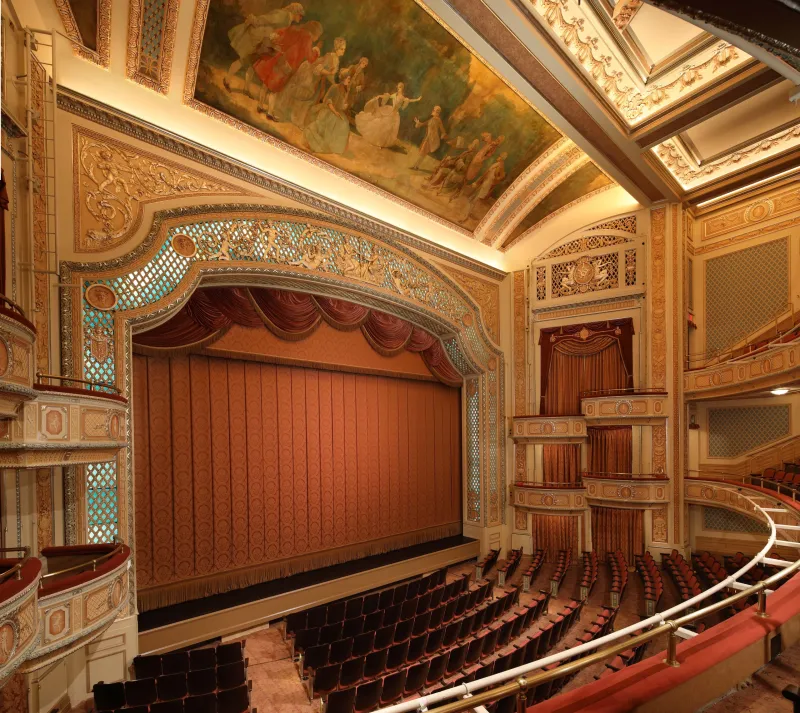
There is a moment, about twelve minutes before curtain, when a West End auditorium stops being a room full of coats and starts being a room with a mood. The house lights are still up. Someone in Row H is wrestling with a bag. The cast board has been photographed. And underneath it all, the house tape is doing its quiet, uncredited work.
You know the tape. You might not have called it that. It's the music that greets you at the door and follows you down the aisle — the jazz standard, the 80s pop, the ambient hum, the suspiciously on-the-nose ballad. It is not the show. It is the warm-up nobody claps.
The uncredited member of the company
In theatre-speak, the house tape (or walk-in music, or pre-show playlist) is the sound that plays while the audience settles. It is usually operated from the sound desk, sometimes from a laptop, occasionally from a system so old that the phrase "don't touch the minidisc player" is still spoken with genuine reverence. It is faded down, not cut, because a hard stop makes an audience feel like they've been told off.
The tape has three jobs, really. It covers the awkward acoustics of a half-full room. It gives the front of house team a sonic cue that doors are open and the countdown has begun. And it primes you — gently, commercially, sometimes hilariously — for the tone of what's to come.
What the choice of music tells you
Walk into a production of a golden-age musical and you'll often get a warm bath of standards: Cole Porter, Gershwin, maybe a soft-focus vocal that makes the chandeliers feel even more chandelier-ish. It says: settle in, we're doing something classic, and we're not going to make you work for it.
Walk into a new play with a sharp comic edge and the tape may be doing something else entirely. A mischievous pop track. A slice of vintage funk. Something with a wink in it. That's not an accident. It's a mood board you can hear, and it's usually chosen by the sound designer or the producer in conversation with the marketing team — the people who know that the first ten minutes in the auditorium are part of the show's personality.
Then there's the budget tell. A tightly curated, show-specific playlist — licensed properly, sequenced with care, faded with finesse — costs money and thought. A generic jazz compilation that could be any theatre on any night is not a crime, but it is a signal. It says: the money went onstage, and the tape is doing a functional job. Neither is better. They're just different kinds of honesty.
The licensing bit nobody puts on a poster
Here's the less glamorous truth: you can't just plug in your Spotify account and press play in a West End foyer. Public performance of recorded music requires licensing — in the UK, that generally means PRS for Music and PPL — and theatres are careful about it. The house tape is a licensed, logged, rights-cleared affair. Which is why some venues stick to a trusted catalogue and others pay for the privilege of a bespoke mix.
It also explains why the tape sometimes feels oddly safe. A jazz trio, a bit of soft soul, a tasteful instrumental. The music has to work for a room full of strangers with different tastes, different ages and different levels of pre-show chatter. It is background music with a job description.
The fade is the thing
Watch a good sound operator work the tape and you'll see a small piece of theatre in itself. Two minutes to curtain, the volume dips. Ninety seconds, a slight lift in the foyer chatter as people realise. Then the fade — not a chop — into the show's opening. If the tape is well chosen, the transition feels like a hand on the shoulder. If it's not, you get that peculiar jolt when the show starts and the audience is still mentally in the car park.
The best house tapes don't try to be the show. They're the handshake before the conversation. They tell you where you are, who you're with and what kind of evening this is going to be. And then, like any good warm-up act, they get out of the way.
A small taxonomy of the West End house tape
- The Jazz Standard: brushed drums, double bass, a piano that sounds like it's been in the family for generations. Reassuring, licensed, faintly expensive.
- The Nostalgia Pop: a run of 80s or 90s hits that makes the audience of a certain age go "oh, I'd forgotten this one" before the lights even dip. Often a comedy.
- The Ambient Drone: less a playlist, more a mood. Common in new writing and anything with a design-heavy set. It says: we are serious, and possibly a bit tense.
- The Show-Adjacent Mix: songs by the same artists, or from the same era, as the production. Effective, slightly on the nose, and absolutely fine.
- The Generic Catalogue: pleasant, forgettable, professionally licensed. The house tape as utility.
Listen before you sit
Next time you're in a West End auditorium with ten minutes to spare, stop reading the programme and listen. The tape is telling you something. It's telling you how much the production trusts its own atmosphere, how it wants you to feel before the first line, and whether it has a sense of humour. It is the only part of the evening that is designed entirely for the bit before the evening starts.
And if you catch yourself humming it in the interval? That's the house tape doing its job. No bow necessary.