The Disembodied Voice of the West End: Who's Really Telling You to Put Your Phone Away?

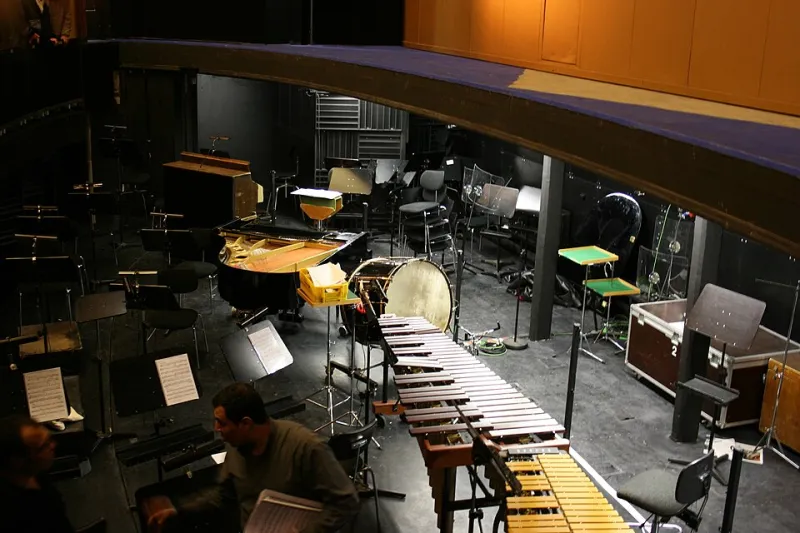
Photo: Warren LeMay from Cincinnati, OH, United States, CC0, via Wikimedia Commons
There's a moment, roughly four minutes before curtain, when a West End auditorium goes quiet in a very particular way. Not the hush of the show starting. More the hush of several hundred people being gently told off by a disembodied voice from the ceiling. Please be aware that the taking of photographs, filming or recording of this production is strictly prohibited. Please ensure mobile phones are switched off. And please, if you can, unwrap your sweets now rather than in the second act.
It is the most performed piece of theatre in London. Nobody claps it. Nobody reviews it. But it happens eight times a week in almost every house in the West End, and it is far more carefully made than you'd think.
The Invisible Warm-Up Act
The industry calls it the "voice of god" — VOG, if you're in a technical rehearsal and feeling brisk. In its simplest form it's a recorded announcement played through the front-of-house system, usually triggered by the stage manager or the sound desk at a set time. In its grander form, it's a live microphone, a company manager with a decent speaking voice and a script that has been refined over decades.
Either way, its job is not just admin. It's atmosphere. A good VOG settles a room. It gives the audience permission to stop rustling and start listening. It also covers the awkward gap between "we're all seated" and "the lights are going down", which is when people tend to do something regrettable with a Butterkrust wrapper.
Different theatres have different styles. Some go full legal warning, solemn as a bank advert. Others are warmer, almost chatty, with a reminder about the cloakroom and a nudge towards the bar. The really good ones sound like a person, not a policy.
Who Actually Records These Things?
The answer is usually less glamorous than the voice suggests. Most VOGs are recorded in-house by the theatre's own staff — a company manager, a duty manager, sometimes the sound designer. They're done in a quiet hour, often in a dressing room with a duvet over the door, or in the sound booth with a microphone that costs more than the average ticket.
Then there are the star names. Several West End theatres have, over the years, persuaded a well-known actor to record the pre-show spiel — sometimes as a favour, sometimes as a charm offensive. The result is a strange little thrill: you're sitting in Row M, and suddenly a very famous voice is asking you to check your phone is off. These recordings are closely guarded and rarely updated. A star VOG can run for years, long after the actor has left the production, which occasionally leads to a delightful mismatch: a 2026 audience being told to behave by a voice from a show that closed a decade ago.
When the Wrong Voice Booms
The VOG is also a live technical cue, which means it can go wrong. The most common mishap is the wrong file. Every theatre has a folder of announcements — standard, relaxed performance, signed performance, "we're running ten minutes late", "please note there is no interval" — and occasionally the wrong one gets triggered.
I've heard of a press night where the relaxed-performance announcement played by mistake, promising that "audience members are welcome to move around and make noise". The room took it in good humour. I've heard of another where the "no interval" announcement played for a show that definitely had an interval, causing a small stampede for the bar at the first blackout.
And then there's the cold. A recorded VOG doesn't get ill, but the person who records a live one does. A company manager with a streaming cold, trying to sound authoritative while also sounding like a blocked drain, is a very specific West End pleasure. You can hear the effort. You can also hear the moment they decide to push through and finish the paragraph about the fire exits.
The Star Name in the Ceiling
Why do theatres bother with famous voices? Partly because it's fun. Partly because a recognisable voice cuts through the chatter in a way that a generic announcement doesn't. When you hear a voice you know, you look up. You pay attention. You might even smile.
But there's a subtler reason too. The VOG is the first taste of the show's personality. If the production is a frothy musical, the announcement might be playful. If it's a serious play, it'll be sober. If it's a panto, all bets are off. The voice sets a tone before a single actor has walked on stage.
Some theatres have leaned into this. I've heard of a VOG that begins with a full orchestral sting, as if the announcement itself is a number. I've heard of one that ends with a gentle reminder to "enjoy the show, and please don't talk during the second half — the actors can hear you". That last one is not strictly true, but it works.
A Small Ritual, Perfectly Timed
The best VOGs are short. They know you've paid for a babysitter and a Tube fare and a glass of something in the interval, and they don't want to waste your time. They get in, they say their piece, they get out. They are the theatrical equivalent of a good maître d': present, reassuring, and gone before you notice.
So next time you're sitting in a West End auditorium, waiting for the lights to dim, listen to the voice from above. It's not just a list of rules. It's a performance. It's someone's job. And if it's a famous actor asking you to turn off your phone, it's also a small, ridiculous privilege.
Then switch off your phone. Properly. She can see you.